
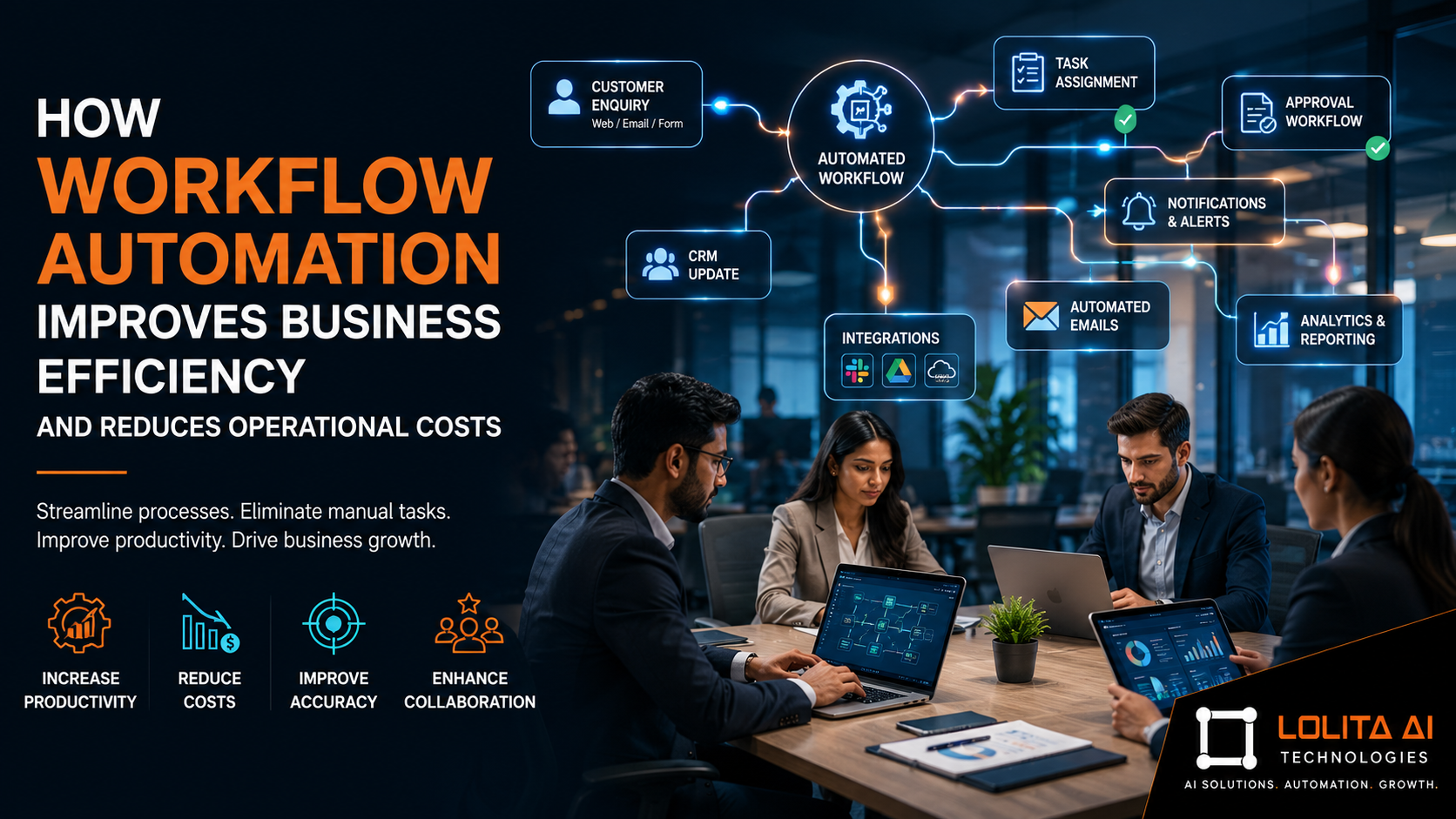
How Workflow Automation Improves Business Efficiency and Reduces Operational Costs
Introduction
Businesses today face increasing pressure to deliver faster services, reduce operational costs, and improve productivity while maintaining exceptional customer experiences. Despite rapid technological advancements, many organizations still rely on manual processes for approvals, document management, customer support, employee onboarding, and repetitive administrative tasks. These activities consume valuable time, increase operational expenses, and often result in avoidable human errors.
Workflow Automation is helping businesses overcome these challenges by automating repetitive processes through intelligent software, artificial intelligence (AI), and predefined business rules. Instead of spending valuable time on routine tasks, employees can focus on innovation, customer relationships, and strategic decision-making.
This article explores what workflow automation is, why businesses are investing in it, its key benefits, industry applications, and how Lolita AI Technologies helps organizations achieve operational excellence through AI-powered automation.
What is Workflow Automation?
Workflow Automation is the process of using software to automate repetitive business activities based on predefined rules and workflows. It enables tasks, approvals, notifications, and data transfers to occur automatically without continuous human intervention.
For example, when a customer submits an enquiry through a company's website, the system can automatically assign the lead to the sales team, send a confirmation email, update the CRM, notify the relevant manager, and schedule follow-up reminders. These tasks happen within seconds without manual effort.
Workflow automation improves efficiency, eliminates bottlenecks, and ensures every business process follows a standardized and reliable sequence.
Why Businesses Need Workflow Automation
Many organizations struggle with operational inefficiencies because employees spend a significant portion of their day performing repetitive administrative work.
Common business challenges include delayed approvals, manual data entry, slow customer response times, communication gaps between departments, duplicate work, documentation errors, and lack of process visibility.
As businesses grow, these inefficiencies increase operational costs and reduce productivity. Workflow automation addresses these challenges by creating structured, intelligent, and scalable business processes that improve speed, consistency, and operational performance.
Key Benefits of Workflow Automation
Increased Productivity
Automation reduces repetitive manual work, allowing employees to focus on strategic initiatives, innovation, customer engagement, and business growth.
Reduced Operational Costs
Automating repetitive processes minimizes labor-intensive activities, reduces errors, and improves resource utilization, resulting in lower operational expenses.
Improved Accuracy
Standardized workflows significantly reduce human errors in data entry, approvals, invoicing, reporting, and documentation, leading to greater business reliability.
Faster Decision Making
Automated notifications, approvals, and real-time reporting enable managers to access accurate information quickly and make better business decisions.
Enhanced Customer Experience
Customers expect fast, accurate, and personalized service. Workflow automation enables businesses to respond more quickly, improve communication, and deliver a consistent customer experience.
Better Team Collaboration
Automation connects departments by automatically sharing information between sales, marketing, finance, HR, customer support, and operations, improving transparency and accountability.
AI-Powered Workflow Automation vs Traditional Automation
Traditional workflow automation follows predefined business rules to automate repetitive tasks.
AI-powered workflow automation goes beyond simple automation by enabling intelligent decision-making. Artificial Intelligence can prioritize customer enquiries, classify documents, analyze business data, predict customer behavior, recommend actions, detect anomalies, and continuously optimize business processes.
This combination of automation and intelligence creates smarter, more adaptive business operations.
Real-World Applications of Workflow Automation
Workflow automation delivers measurable value across multiple business functions.
Sales teams use automation for lead assignment, proposal generation, CRM updates, follow-up reminders, and customer onboarding.
Human Resources departments automate employee onboarding, leave approvals, attendance management, recruitment workflows, and document verification.
Finance teams automate invoice approvals, purchase requests, expense management, payment processing, and financial reporting.
Customer support departments automate ticket routing, complaint escalation, automated responses, SLA monitoring, and customer feedback collection.
Marketing teams automate email campaigns, lead nurturing, campaign tracking, social media scheduling, and marketing analytics.
Industries That Benefit from Workflow Automation
Workflow automation is transforming organizations across healthcare, manufacturing, logistics, retail, e-commerce, banking, financial services, education, real estate, information technology, and professional services.
Any organization with repetitive business processes can improve efficiency through automation.
Signs Your Business Needs Workflow Automation
Your business should consider workflow automation if employees spend excessive time on repetitive tasks, customer enquiries receive delayed responses, approvals take several days, information is manually entered into multiple systems, communication between teams is inconsistent, operational costs continue increasing, business processes lack visibility, or manual errors frequently occur.
These challenges indicate opportunities to improve efficiency through intelligent automation.
Workflow Automation and Digital Transformation
Digital transformation is more than adopting new technology. It involves improving the way businesses operate and deliver value.
Workflow automation supports digital transformation by eliminating manual bottlenecks, increasing operational efficiency, improving data accuracy, enhancing customer experiences, supporting business scalability, and enabling faster organizational growth.
Businesses that embrace workflow automation are better positioned to adapt to changing customer expectations and evolving market conditions.
How Lolita AI Technologies Helps Businesses
Lolita AI Technologies develops intelligent workflow automation solutions designed to simplify complex business processes and improve organizational efficiency.
Our solutions help businesses automate repetitive operations, streamline internal workflows, improve collaboration between departments, reduce operational costs, increase productivity, integrate Artificial Intelligence into existing business systems, and accelerate digital transformation.
Whether you are a startup, small business, or enterprise, our experienced team delivers scalable automation solutions tailored to your unique business requirements.
Frequently Asked Questions
What is Workflow Automation?
Workflow automation uses software and Artificial Intelligence to automate repetitive business tasks, approvals, notifications, and workflows without constant manual intervention.
How is Workflow Automation different from Business Process Automation?
Workflow automation focuses on automating individual workflows or specific tasks, while Business Process Automation optimizes complete end-to-end business processes across multiple departments.
Can small businesses benefit from Workflow Automation?
Yes. Small businesses can automate customer enquiries, appointment scheduling, invoicing, email marketing, employee onboarding, and internal approvals to improve productivity and reduce operational costs.
Is Workflow Automation expensive?
Modern workflow automation solutions are scalable and can be implemented based on an organization's size and budget. Most businesses recover their investment through improved efficiency and reduced operational expenses.
Does Workflow Automation replace employees?
No. Workflow automation eliminates repetitive manual work, allowing employees to focus on higher-value activities such as innovation, customer relationships, strategy, and business growth.
Conclusion
Workflow automation has become an essential component of modern business operations. By automating repetitive tasks, improving collaboration, reducing operational costs, increasing productivity, and enhancing customer experiences, businesses can build more efficient and scalable organizations.
Organizations that adopt AI-powered workflow automation today will gain a competitive advantage while preparing for the future of digital business.
At Lolita AI Technologies, we help businesses transform manual operations into intelligent, automated workflows that drive efficiency, innovation, and sustainable growth.
Ready to Transform Your Business?
If you're looking to streamline operations, improve productivity, and accelerate digital transformation, Lolita AI Technologies is here to help. Contact our team today to discover how our AI-powered Workflow Automation solutions can optimize your business processes and support long-term success.