What Is AI Automation? Benefits, Examples & Business Applications | Lolita AI Technologies
What Is AI Automation and Why Are Businesses Investing in It?
If you've spent any time reading about technology trends lately, you've probably come across the term "AI Automation." It's one of those buzzwords that seems to be everywhere. Every software company talks about it. Every startup wants it. Every business leader is curious about it.
But what does AI automation actually mean? More importantly, is it something only large enterprises need, or can it genuinely help small and growing businesses too? The answer might surprise you. The Problem Most Businesses Face Let's start with a simple question. How much time does your team spend on repetitive tasks every week?
Think about activities like:
• Responding to the same customer questions repeatedly
• Manually updating spreadsheets
• Following up with leads
• Assigning tasks to team members
• Processing invoices
• Updating CRM records
• Managing inventory data
Individually, these tasks don't seem like a big deal.
But collectively, they consume hundreds of hours every month.
Many businesses hire more people to handle the growing workload.
Others try to manage everything manually until operations become overwhelming.
That's where AI automation comes in.
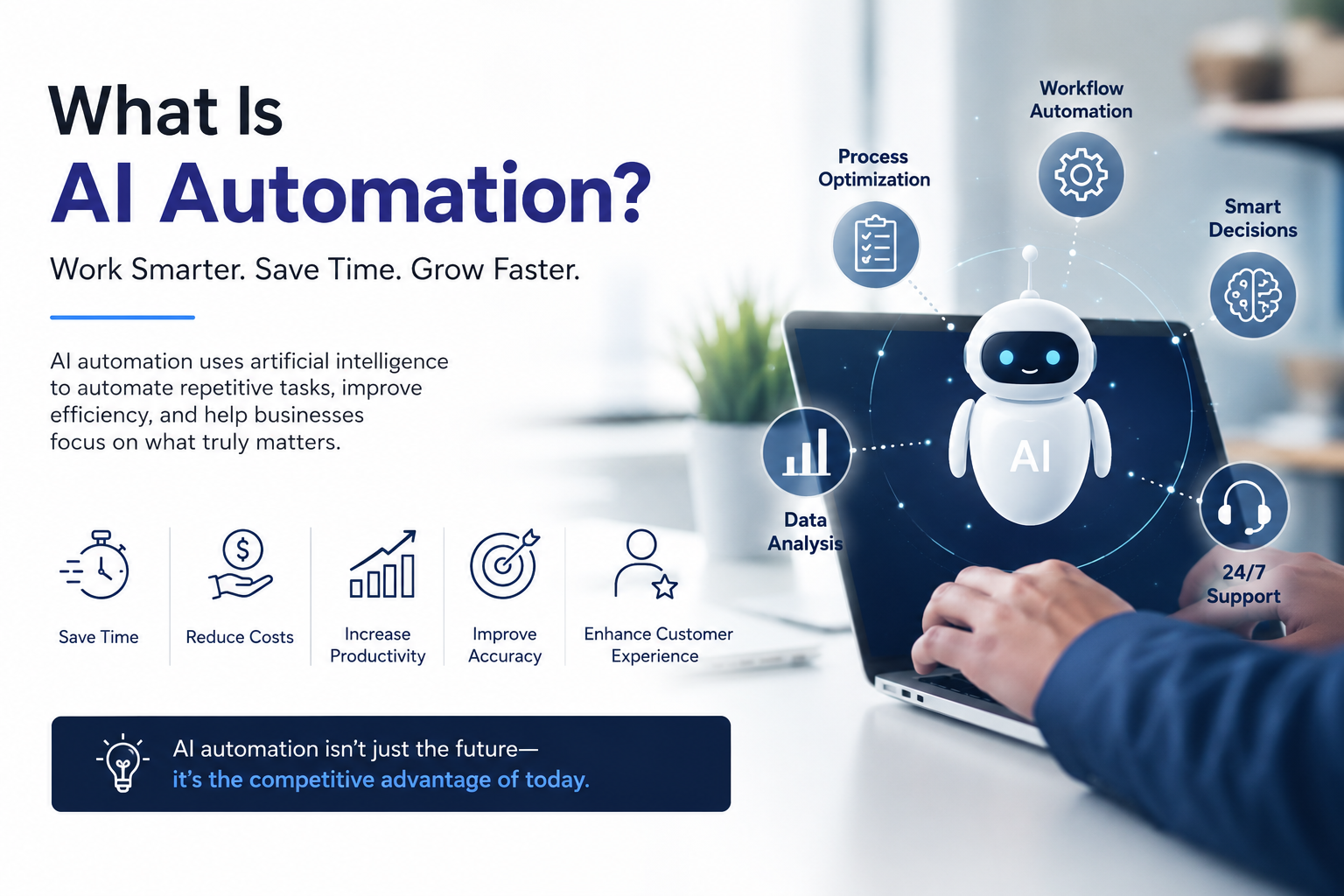
What Is AI Automation?
AI automation is the process of using artificial intelligence to perform tasks that would normally require human effort.
Unlike traditional automation, which follows fixed rules, AI systems can learn from data, understand patterns, and make decisions based on information.
In simple terms: Traditional automation follows instructions.
AI automation learns and improves over time.
Why Businesses Are Adopting AI Automation
The main reason isn't technology.
It's efficiency.
Business owners aren't investing in AI because it's trendy. They're investing because it helps them save time, reduce costs and scale operations without constantly increasing manpower.
Here are some of the biggest benefits businesses are seeing today.
Increased Productivity
Imagine a customer support team handling hundreds of inquiries every day.
Instead of answering every question manually, AI can instantly respond to common requests, freeing employees to focus on more complex issues.
The result? Faster response times and happier customers.
Reduced Operational Costs
Every repetitive task completed by AI reduces the amount of manual work required. Businesses can allocate their resources more effectively without sacrificing quality
Better Accuracy
Humans make mistakes.
We miss details, enter incorrect data, and occasionally overlook important information.
AI systems can process large amounts of information consistently and accurately.
Faaster Decision-Making
Modern AI systems can analyze data in seconds and provide actionable insights.
Instead of spending hours creating reports, businesses can access information almost instantly.
Real-World Examples of AI Automation
Many people think AI automation is something futuristic.
The reality is that you're probably interacting with AI automation every day.
Customer Support
When you chat with a company online and receive an instant response, there's a good chance AI is involved.
AI chatbots can:
• Answer customer questions
• Track orders
• Schedule appointments
• Escalate issues when needed
Sales and Lead Management
Sales teams often spend hours qualifying leads.
AI can automatically:
• Score leads
• Send follow-up emails
• Schedule meetings
• Update CRM systems
Workflow Management
Businesses use AI to automate:
• Employee onboarding
• Approval workflows
• Project management
• Internal communication
E-commerce Online stores use AI for:
• Product recommendations
• Inventory forecasting
• Customer support
• Personalized shopping experiences
AI Automation vs Traditional Automation
A common misconception is that AI automation and traditional automation are the same thing.
They're not.
Traditional automation is rule-based.
For example: "If a customer submits a form, send an email."
That's automation.
AI automation goes further.
For example:
"Analyze customer behavior, determine buying intent, personalize communication, and recommend the next best action."
That's intelligence combined with automation.
The difference becomes more noticeable as businesses grow and processes become more complex.
Which Industries Benefit Most From AI Automation?
Almost every industry can benefit from AI automation in some way.
However, adoption is growing particularly fast in:
• Healthcare
• Appointment scheduling
• Patient communication
• Medical data processing Real Estate
• Lead qualification
• Property recommendations
• Automated follow-ups Education
• Student engagement
• Administrative tasks
• Personalized learning experiences E-commerce
• Inventory management
• Customer service
• Marketing automation Finance
• Fraud detection
• Risk assessment
• Data analysis
Is AI Automation Only for Large Companies?
Not anymore.
A few years ago, implementing AI solutions required significant investment.
Today, businesses of all sizes can access AI-powered tools and custom automation
solutions.
In fact, many small and medium-sized businesses often see the fastest results because
they can eliminate bottlenecks and improve efficiency quickly.
The key is identifying processes that consume time and finding opportunities to
automate them strategically.
How to Get Started With AI Automation
If you're considering AI automation for your business, start by asking:
• Which tasks are repetitive?
• Which processes take the most time?
• Where do errors occur frequently?
• What activities prevent your team from focusing on growth?
The answers often reveal the best opportunities for automation.
Rather than automating everything at once, successful businesses usually start with
one process, measure results, and expand gradually.
How Lolita AI Technologies Helps Businesses
At Lolita AI Technologies, we work with businesses that want to move beyond
manual operations and build smarter, more scalable systems.
Our expertise includes:
• Custom AI Solutions
• Workflow Automation
• Automation Solutions
• Robotic Process Automation (RPA)
• MVP Development
• Custom Software Development
Every business operates differently, which is why we focus on building solutions tailored to specific goals and challenges rather than applying a one-size-fits-all
approach.
Final Thoughts
AI automation isn't about replacing people.
It's about allowing people to spend less time on repetitive tasks and more time on meaningful work.
Businesses that embrace automation today aren't just improving efficiency, they're creating a foundation for future growth.
Whether you're a startup looking to scale or an established company aiming to streamline operations, AI automation offers opportunities to work smarter, serve customers better, and stay competitive in an increasingly digital world.
The question is no longer whether businesses should adopt AI automation.
The question is where they should start.